

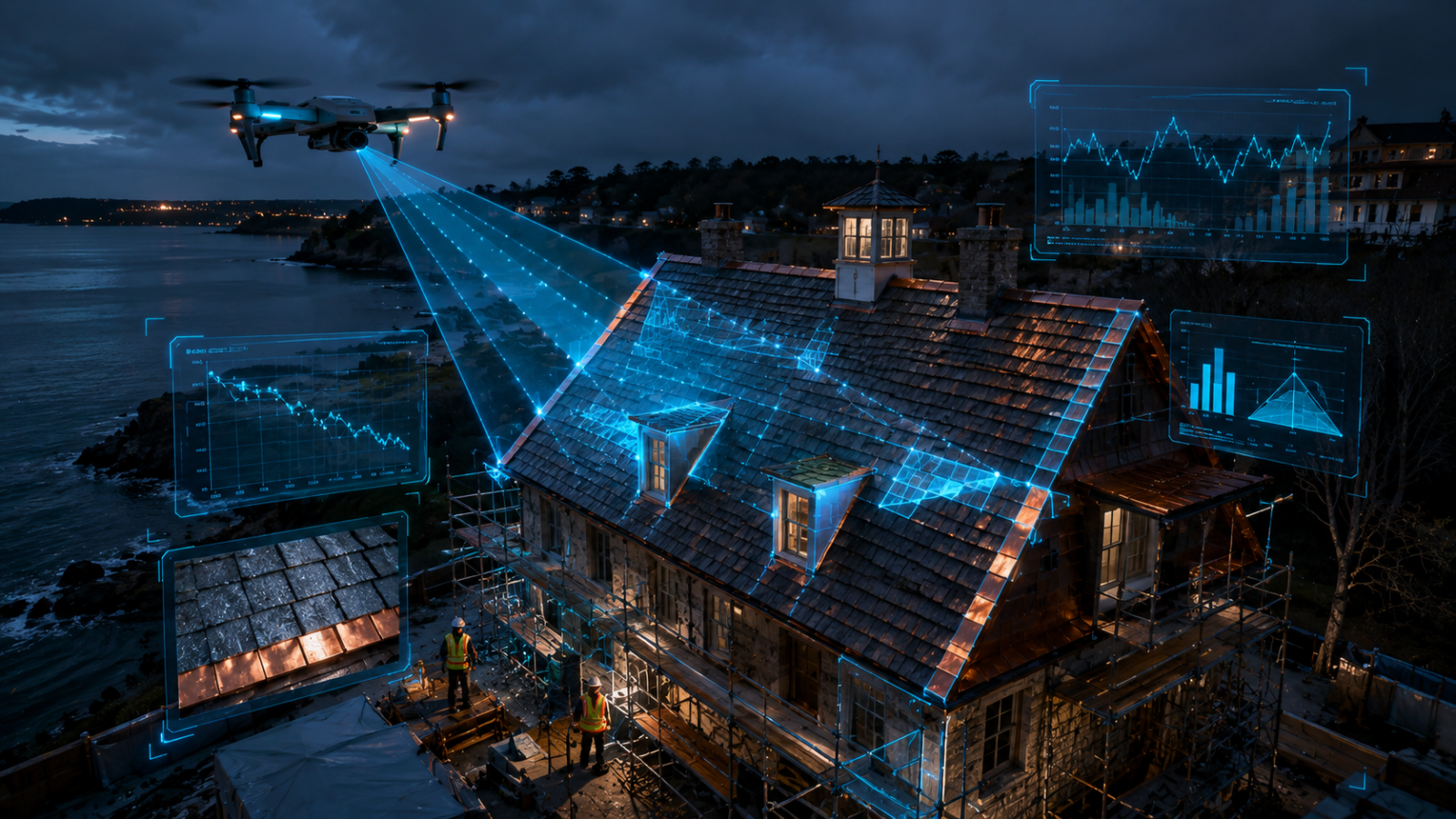
Construction is one of the last major industries to be substantially reshaped by artificial intelligence — and the transformation, when it arrived, came faster and ran deeper than most of the sector anticipated. Where manufacturing automated assembly lines decades ago and logistics optimized routing through algorithmic dispatch, construction remained stubbornly dependent on human judgment, site-specific expertise, and accumulated craft knowledge that resisted digitization.
That resistance is breaking down. AI systems are now being deployed across the full construction lifecycle — from generative design tools that optimize structural configurations before a single beam is placed, to computer vision platforms that monitor build quality in real time, to predictive maintenance models that calculate material degradation curves under specific environmental conditions. The industry that once ran on clipboards and decades of accumulated tradesperson knowledge is building a parallel layer of machine intelligence — and the implications for quality, longevity, and cost are significant.
The Data Problem Construction Never Solved
Before understanding what AI is doing to construction, it helps to understand what made the industry so difficult to digitize in the first place. Unlike manufacturing, where inputs and outputs can be precisely controlled, construction is a fundamentally outdoor, site-specific activity where conditions change daily and no two projects are identical. The knowledge that determines whether a coastal renovation will last 40 years or fail in 12 lives in the hands of experienced craftspeople — in their understanding of how specific materials behave under specific environmental conditions, how transition points between systems should be detailed, and how long-term maintenance requirements differ by climate.
This knowledge was always difficult to capture in any systematic form. Project documentation existed, but it was rarely structured enough to be analytically useful at scale. Material specifications were recorded; the reasoning behind material selection decisions usually was not. Inspection reports logged outcomes; the leading indicators that preceded failure were rarely tracked in ways that allowed pattern recognition across projects.
AI’s entry into construction began, in practical terms, with solving this data problem — creating systems that could ingest unstructured project documentation, site photography, sensor readings, and maintenance records, and extract the patterns that experienced practitioners carry in their heads.
Predictive Material Degradation: What the Models Are Learning
The most commercially mature AI applications in construction today are in predictive maintenance and material degradation modeling. The core problem these systems solve is straightforward to describe and historically very difficult to quantify: given a specific material, in a specific environment, under a specific maintenance regime, when will it fail — and what will the failure mode be?
This is not a trivial question. The lifespan of a cedar shake roof on a coastal New England property, for instance, is influenced by at least a dozen interacting variables: the grade and grain pattern of the cedar, the underlayment system, the ventilation design, proximity to salt water, prevailing wind direction, annual precipitation, UV exposure hours, maintenance frequency, and the quality of transition details at every junction in the roofing system. Human experts develop intuitions about these interactions over careers. AI systems are now being trained to model them explicitly.
The technical deep-dive documentation that premium contractors produce for complex projects — like this detailed account of a cedar and copper coastal renovation in Woods Hole, Massachusetts, which covers material specifications, installation protocols, thermal expansion detailing, and environmental stress modeling — represents exactly the kind of structured expert knowledge that the best predictive maintenance AI is trained on. The specificity of this data — copper flashing gauges, EPDM elongation values, fastener specifications by coastal exposure zone — is what separates useful training data from generic construction records.
Computer Vision on the Job Site
The second major AI application reshaping construction is computer vision — machine learning systems that can analyze photographs, drone footage, and video streams from active construction sites to detect quality issues, verify specification compliance, and flag deviations from design intent before they become embedded problems.
The practical application works at several levels of granularity. At the broadest level, drone-captured aerial imagery analyzed by object detection models can track site progress against schedule, identify material staging issues, and verify that structural elements are positioned correctly. At a finer level, close-range photogrammetry combined with trained classification models can detect installation defects — improper fastener spacing, inadequate weather resistive barrier laps, insufficient flashing integration depth — that human inspectors miss under time pressure.
The more interesting frontier is at the junction level: training models to evaluate not just whether individual components are correctly installed, but whether the relationships between components at transition points meet specification. This is the hardest problem in construction quality control because transition details are where the most consequential failures originate, and they are also the details most commonly under-documented in standard inspection protocols.
Generative Design: AI as Structural Engineer
Generative design tools represent AI’s most visible entry into the front end of construction — the design and specification phase rather than execution and maintenance. These systems take engineering constraints as inputs — load requirements, material properties, cost targets, environmental exposure parameters — and use optimization algorithms to explore a solution space that would take human engineers months to manually evaluate.
The results are structures that often look unlike anything a human designer would produce intuitively, because they are optimized for performance rather than shaped by design conventions. Generative structural topologies route material precisely along load paths, eliminating mass from areas where it contributes nothing to structural performance. The aesthetic is strange by conventional standards; the engineering logic is often impeccable.
For high-performance applications — aerospace structures, custom building components, specialized civil infrastructure — generative design is already delivering measurable improvements in material efficiency and structural performance. For mainstream construction, the limiting factor remains not algorithmic capability but the manufacturing pipeline: most construction still requires materials and components that exist in standard forms, and generative design’s most dramatic outputs often require custom fabrication that the broader supply chain cannot accommodate economically.
Digital Twins: The Living Model of a Building
Perhaps the most significant long-term AI application in construction is the digital twin — a continuously updated computational model of a physical structure that incorporates real-time sensor data, maintenance records, and environmental monitoring to provide an always-current picture of the building’s condition.
The concept is straightforward in principle. Every significant building element — structural members, roofing systems, mechanical equipment, envelope assemblies — has a known performance envelope and a degradation curve under specific conditions. If you can monitor the actual conditions a building experiences and update the model continuously, you can predict with increasing precision when components will approach the end of their service life, what maintenance interventions will extend that life most cost-effectively, and where inspection resources should be prioritized.
In practice, implementing a full digital twin requires solving several hard problems simultaneously: sensor density sufficient to monitor conditions at meaningful resolution, data pipeline reliability sufficient to keep the model current, and predictive model accuracy sufficient to make actionable maintenance recommendations. Each of these problems is solvable with current technology; doing all three economically for mid-market construction projects remains an active engineering challenge.
How AI Models Learn Construction Expertise
The quality of AI systems in construction depends directly on the quality of the training data — and this creates a significant challenge. The most valuable construction knowledge is not in generic building codes or manufacturer specification sheets. It is in the project-specific decision documentation produced by the most skilled practitioners: the reasoning behind material selection choices in specific environmental contexts, the detailed protocols for installation sequences in complex multi-system assemblies, the inspection criteria that distinguish acceptable from unacceptable work at each stage of a project.
This knowledge is sparse, unevenly distributed, and often guarded. The contractors and craftspeople who produce the best work also tend to produce the most thorough project documentation — but they have limited incentive to make that documentation available for AI training. The result is that construction AI systems are often trained on a combination of code-compliant documentation, academic research, and the relatively small subset of expert project records that enter the public domain.
Closing this data gap is one of the most consequential challenges in construction AI. The systems that will eventually model material degradation, junction performance, and long-term maintenance requirements with genuinely useful precision will be trained on detailed, expert-produced project documentation — the kind that captures not just what was built, but why specific decisions were made and what the reasoning was behind each choice.
AI Applications Across the Construction Lifecycle
| Phase | AI Application | Technology | Maturity Level | Key Benefit |
|---|---|---|---|---|
| Design | Generative structural optimization | Evolutionary algorithms, topology optimization | Commercially deployed | Material efficiency, performance-optimized geometry |
| Pre-construction | Cost and schedule prediction | Regression models, NLP on historical bids | Widely available | Reduced estimation variance, earlier risk identification |
| Site execution | Quality control via computer vision | Object detection, defect classification CNNs | Early deployment | Real-time defect detection, specification compliance verification |
| Site execution | Progress monitoring via drone | Photogrammetry, semantic segmentation | Commercially deployed | Schedule tracking, deviation detection |
| Handover | As-built documentation generation | LiDAR + point cloud processing, NLP | Early deployment | Accurate record sets, reduced handover disputes |
| Operations | Predictive maintenance modeling | Time-series regression, survival analysis | Commercially deployed | Extended asset life, optimized maintenance scheduling |
| Operations | Digital twin management | IoT integration, physics-informed ML | High-value projects | Continuous condition awareness, lifecycle cost reduction |
The Limits of What AI Can Currently Model
For all the genuine progress, it is important to be clear about what current AI systems cannot do in construction — and where human expertise remains irreplaceable.
AI systems are effective at pattern recognition within their training distribution. They identify defects that look like defects they have seen before; they predict material failure modes that resemble failure modes in their training data; they optimize designs within constraint frameworks that have been explicitly defined. What they cannot do reliably is identify novel failure modes, reason about the systemic consequences of decisions at complex multi-system junctions, or apply the kind of contextual judgment that an experienced contractor brings to a problem that does not fit any prior template.
The most consequential decisions in high-quality construction — the reasoning behind a specific copper flashing gauge choice in a high-salt-spray coastal environment, the decision to use hand-woven corners on yellow cedar siding rather than standard corner boards, the choice of fastener specification at a EPDM-to-cedar transition point — require an integration of material science knowledge, local climate understanding, and craft experience that current AI systems can assist but cannot replace.
This is not a criticism of AI’s role in construction. It is a precise description of where the value lies: AI amplifies expert judgment, automates pattern recognition at scale, and systematically captures knowledge that would otherwise remain tacit. It does not yet substitute for the judgment itself.
What the Next Five Years Look Like
The trajectory of AI in construction over the next five years will be shaped by three developments that are already underway.
First, sensor costs will continue falling, making continuous building monitoring economically viable for a much broader range of projects. The digital twin model, currently cost-effective only for large commercial and institutional buildings, will become accessible for mid-market construction as the hardware infrastructure becomes affordable.
Second, large language models trained on structured construction documentation will become increasingly capable of extracting and synthesizing the expert knowledge currently locked in project records, inspection reports, and maintenance logs. This will accelerate the training data problem for specialized AI systems and enable more sophisticated natural language interfaces for construction professionals who lack data science backgrounds.
Third, computer vision models for construction quality control will improve substantially as more labeled training data becomes available from early deployments. The systems that today can detect obvious installation defects will progressively become capable of evaluating the more subtle quality indicators — junction detailing quality, fastener pattern consistency, material condition at time of installation — that currently require experienced human inspection.
Frequently Asked Questions
How is AI currently being used in construction quality control?
The most mature applications use computer vision systems — trained convolutional neural networks — to analyze site photography and drone footage for installation defects, specification deviations, and progress against schedule. These systems are effective at detecting defects that appear clearly in visual data: missing fasteners, incorrectly positioned structural elements, inadequate overlap at waterproofing details. More subtle quality indicators, particularly at system junctions and transition details, remain difficult for current models to evaluate reliably.
What data do predictive maintenance AI models need to be accurate?
Effective predictive maintenance models require structured records of material specifications, installation conditions, environmental exposure data, maintenance history, and observed failure events across a population of similar projects. The more specific this data — material grade, installation sequence, climate parameters, inspection frequency — the more accurate the degradation predictions. Generic construction records are insufficient; the high-value training data is the detailed, expert-produced project documentation that the most skilled contractors generate.
What is a digital twin in construction and how does AI enable it?
A digital twin is a continuously updated computational model of a physical building that incorporates real-time sensor data and maintenance records to provide a current picture of the structure’s condition. AI enables digital twins by processing the continuous data streams from building sensors, identifying anomalies that indicate developing problems, and updating degradation models as actual performance data accumulates. The practical challenge is making the required sensor infrastructure and data processing economically viable for mainstream construction projects.
Can AI replace experienced construction tradespeople?
Not in any near-term timeframe for complex, high-quality construction work. AI systems are effective at pattern recognition, scale, and consistency — identifying known defect types, predicting performance within established parameters, automating documentation. What they cannot do is apply the contextual craft judgment that experienced tradespeople bring to novel problems, complex multi-system assemblies, and the kind of site-specific decision-making that high-quality construction demands at every stage. The realistic near-term role of AI in skilled trades is amplification of expert judgment, not replacement of it.
How does generative design work in structural engineering?
Generative design uses optimization algorithms — evolutionary computation, topology optimization, gradient-based methods — to explore a design space defined by engineering constraints and produce structural configurations that meet performance targets with minimum material. The process typically involves defining load cases, material properties, boundary conditions, and performance objectives, then allowing the algorithm to generate and evaluate thousands of structural configurations to identify high-performing solutions. Results often look unlike conventional structural designs because they are optimized for performance rather than shaped by design conventions.
What construction AI applications are most commercially mature today?
Cost and schedule prediction models, drone-based progress monitoring with computer vision analysis, and predictive maintenance systems for building infrastructure are the most widely deployed AI applications in construction today. Generative design tools for structural optimization are established in high-value and technically complex projects. Digital twin systems are commercially deployed for large institutional and commercial buildings. Computer vision for real-time installation quality control is in early commercial deployment, with capabilities expanding as labeled training data accumulates.
How does climate-specific data improve AI construction models?
Construction performance is highly climate-dependent — the same materials and installation methods produce very different long-term outcomes in a coastal salt-spray environment compared to a dry inland climate or a freeze-thaw zone. AI models trained on climate-specific data can make substantially more accurate performance predictions for projects in those specific environments. The challenge is that high-quality climate-specific construction data is sparse; most training datasets aggregate across climates in ways that reduce predictive accuracy for any specific location.
Will AI change how building specifications and codes are written?
Gradually, yes. As AI systems accumulate sufficient performance data to identify patterns that current codes do not capture — specific material combinations that outperform or underperform under specific environmental conditions, installation details that systematically affect long-term performance — this evidence will influence specification standards and building codes. The process is slow by design: building codes are deliberately conservative and change through formal review processes. But the data that AI systems are now beginning to generate systematically will eventually be a significant input into how construction standards evolve.